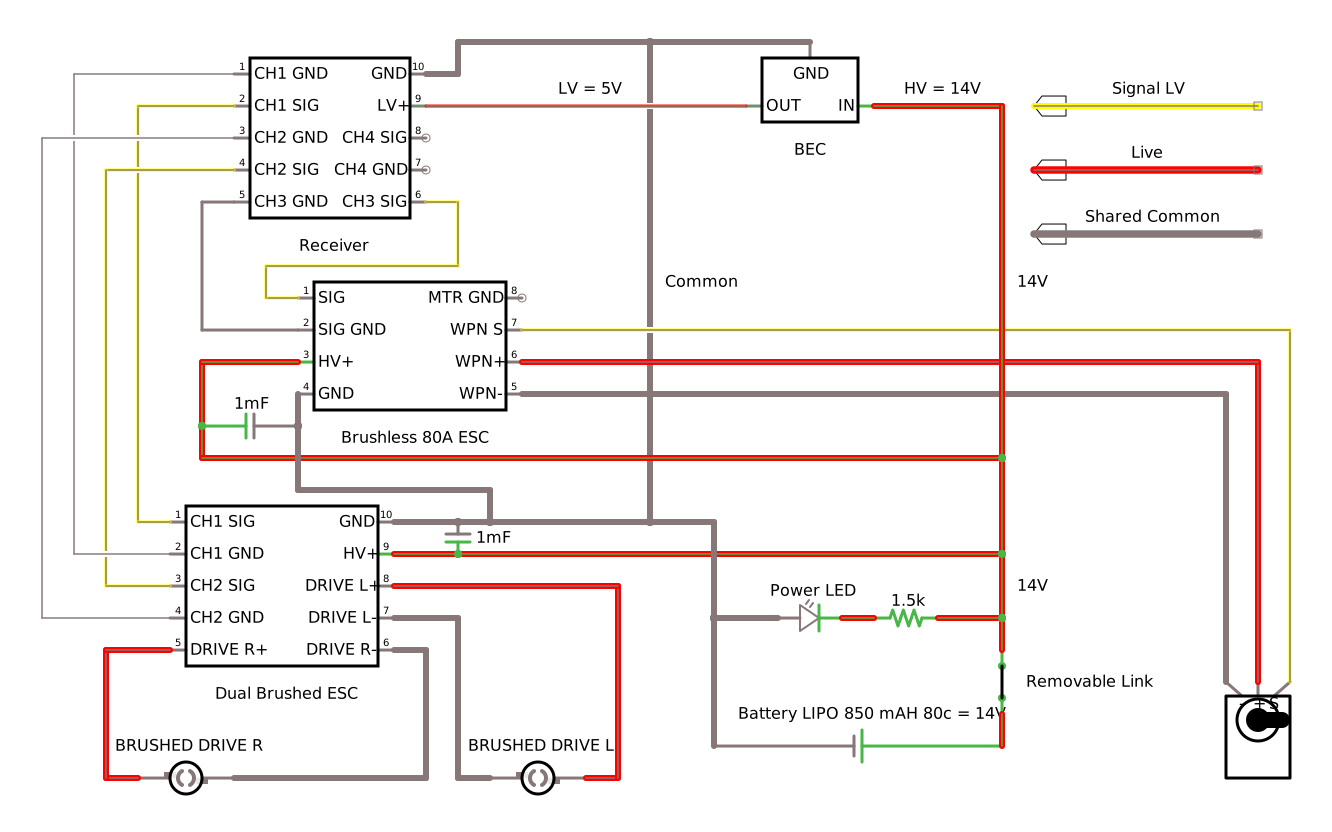
Fighting Robot UOC basic

Power System
The system is powered by a 4S 850mAh LiPo battery connected via an XT60 removable link, which acts as the primary safety isolation device. The removable link is positioned directly after the battery positive terminal, ensuring that removing the link disconnects power to all subsystems, including ESCs, BEC, and receiver.
A power LED with a 1.5 kΩ series resistor is connected on the switched (live) side of the link to indicate when the robot is armed.
High Voltage (HV) Distribution – 14V Rail
The switched 14V rail feeds:
Dual brushed drive ESC
80A brushless weapon ESC
5V BEC (Battery Eliminator Circuit)
All high-current grounds share a common return to battery negative to maintain a unified reference.
Two 1 mF (1000 µF) low-ESR capacitors are installed:
One across the brushless ESC supply
One across the dual brushed ESC supply
These capacitors are placed across HV+ and GND as close as possible to each ESC input to reduce voltage sag, suppress switching noise, and absorb transient spikes generated during rapid motor load changes.
Low Voltage (LV) System – 5V Rail
A 5V 3A BEC converts the 14V supply to a regulated 5V output. This 5V rail powers only the radio receiver.
No ESCs supply 5V to the receiver. Only signal and ground connections are used between ESCs and receiver to prevent backfeeding or regulator conflicts.
All grounds (HV and LV) are tied together to provide a common signal reference.
Control System
A 4-channel FlySky receiver provides independent PWM control:
CH1 → Dual brushed ESC (Drive motor channel 1)
CH2 → Dual brushed ESC (Drive motor channel 2)
CH3 → Brushless 80A ESC (Weapon control)
CH4 → Spare channel (available)
The dual brushed ESC independently drives the left and right brushed gearmotors. The brushless ESC drives the weapon motor via three-phase outputs.
System Architecture Summary
4S LiPo primary power
XT60 removable link safety isolation
Dedicated BEC for receiver power
Independent dual drive control
Independent weapon control
HV noise suppression capacitors
Common ground reference
No parallel 5V regulator conflicts
This configuration provides a robust and competition-safe electrical layout suitable for high-current transient loads typical of combat robotics.
void setup() {
    chipName("Receiver");

    // CH1
    pin(1,  "CH1 GND",     OUTPUT);   // signal
    pin(2,  "CH1 SIG", GROUND);   // ground

    // CH2
    pin(3,  "CH2 GND",     OUTPUT);
    pin(4,  "CH2 SIG", GROUND);

    // CH3
    pin(5,  "CH3 GND",     OUTPUT);
    pin(6,  "CH3 SIG", GROUND);

    // CH4
    pin(7,  "CH4 GND",     OUTPUT);
    pin(8,  "CH4 SIG", GROUND);

    // Power into receiver from BEC
    pin(9,  "LV+",     POWER);
    pin(10, "GND",     GROUND);
}

void loop() {}
void setup() {
    chipName("Dual Brushed ESC");

    // Receiver inputs (each with its own ground reference)
    pin(1,  "CH1 SIG",     INPUT);    // signal
    pin(2,  "CH1 GND", GROUND);   // ground

    pin(3,  "CH2 SIG",     INPUT);
    pin(4,  "CH2 GND", GROUND);

    // Motor outputs (match your labels)
    pin(5, "DRIVE R+", OUTPUT);
    pin(6, "DRIVE R-", OUTPUT);
    pin(7, "DRIVE L-", OUTPUT);
    pin(8, "DRIVE L+", OUTPUT);

    // Battery power into ESC
    pin(9,  "HV+", POWER);
    pin(10, "GND", GROUND);
}

void loop() {}
void setup() {
    chipName("Brushless 80A ESC");

    // Receiver control (signal + ground pair)
    pin(1, "SIG",     INPUT);     // signal from receiver
    pin(2, "SIG GND", GROUND);    // ground reference for signal

    // Battery power input
    pin(3, "HV+", POWER);
    pin(4, "GND", GROUND);

    // Weapon motor outputs (match your schematic exactly)
    pin(5, "WPN-", OUTPUT);
    pin(6, "WPN+", OUTPUT);
    pin(7, "WPN S", OUTPUT);

    // Optional extra ground (keeps simulator stable if needed)
    pin(8, "MTR GND", GROUND);
}

void loop() {}